
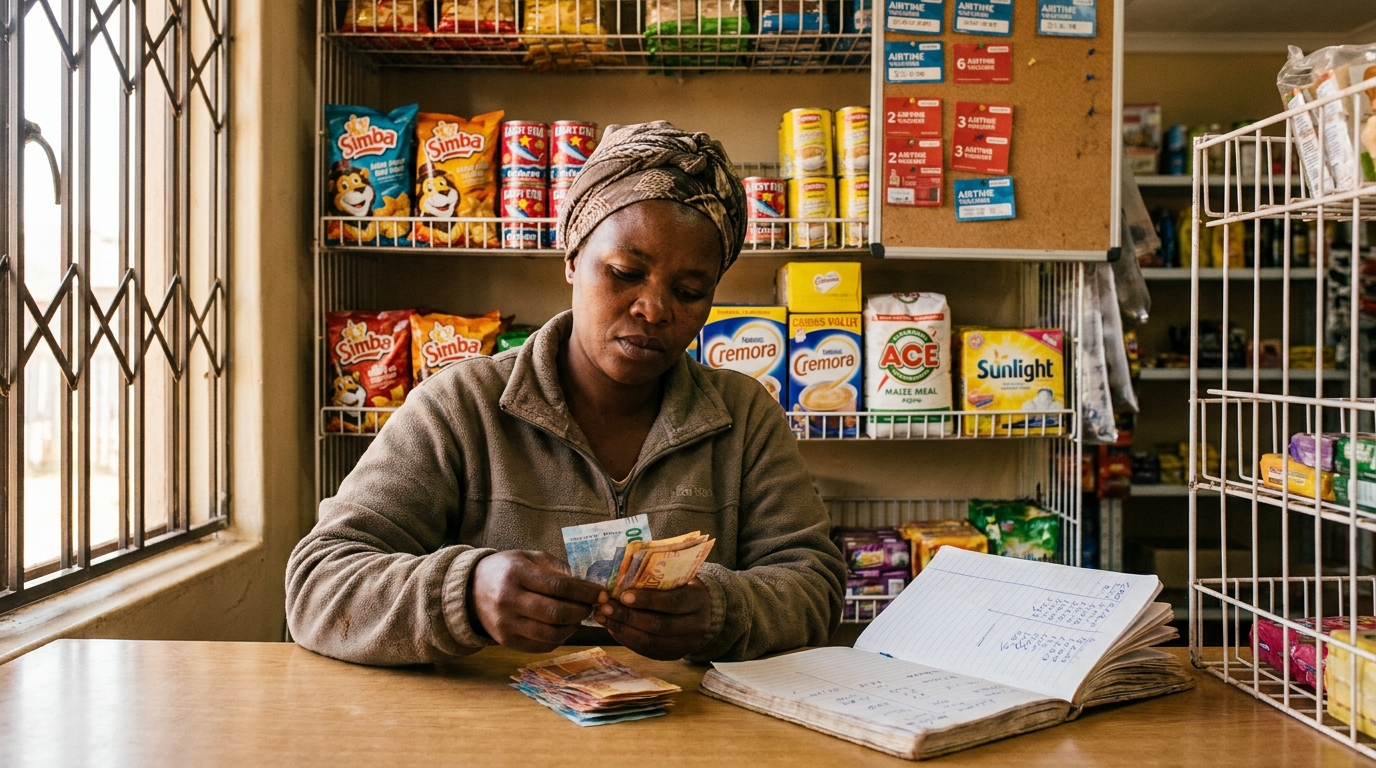
There's an old saying that goes around among accountants: revenue is vanity, profit is sanity, but cash is reality. It sounds cheesy, but every South African small business owner who has ever had to ask a supplier for "a few more days" knows exactly what it means.
You can have a full order book. You can have loyal customers and a product that everyone in the township talks about. You can be profitable on paper. And you can still wake up on a Monday morning unable to pay your staff or restock your shelves — because the money simply isn't in your account yet.
Cash flow is not the same thing as profit. It's the actual movement of money through your business, in real time. And managing it well is one of the most practical skills any entrepreneur can develop. It's the difference between a business that survives a slow January and one that doesn't open its doors in February.
This guide breaks down what cash flow really means, why it trips up so many small businesses in South Africa, and the concrete steps you can take this week to keep yours healthy.
What Is Cash Flow
Cash flow is the movement of money in and out of your business over a given period — usually measured weekly or monthly.
- Positive cash flow means more money is coming in than going out. You can pay your bills, restock, and put something aside.
- Negative cash flow means the reverse — you're spending more than you're receiving, which threatens your ability to keep operating.
Here's the part most owners miss: it is entirely possible to be profitable on paper but cash-flow negative in practice. This is one of the leading reasons small businesses in South Africa fail — not lack of sales, but a mismatch in the timing of when money arrives and when it has to leave.
Consider a spaza shop owner who restocks every Monday. The shop is profitable — she makes a real margin on every item she sells. But most of her regular customers pay at the end of the month when their wages or grants come in. By midweek, she's run out of bread and airtime but doesn't have the cash to reorder. Her business isn't failing — her timing is off.
Or take a small catering business that delivers a R15,000 order for a corporate event. Wonderful margin, profitable job, happy client. But the client pays on 60-day terms. In the meantime, the caterer has paid suppliers, staff, and transport in cash. Six weeks later, she's "profitable" but can't take another order because she has no working capital.
This is why cash flow matters more than profit on a day-to-day basis. Profit tells you if your business model works. Cash flow tells you if your business will still be open next month.
Common Cash Flow Problems in Small Businesses
Most cash flow troubles come from the same handful of causes. If you recognise yours below, you're already halfway to fixing it.
1. Late Payments from Customers
The problem. You've delivered the goods or completed the service, but your money is still sitting in someone else's account. Whether it's a corporate client on 60-day terms, a regular customer who "always pays on the 25th," or a stokvel order paid in instalments — every day they delay is a day you can't use your own money.
In township and informal business, this often takes a softer form: extending credit on a friendly basis. "Don't worry, just pay me when you can." It feels like good community business — until you're the one who can't restock.
The fix
Tighten your payment terms
Require a 50% deposit upfront for any order over a set amount. Offer a small discount (2–5%) for early payment. Where possible, move to cash on delivery.
Make terms explicit
Put payment terms on every invoice and quote — "Payment due in 14 days" — so there's no ambiguity later.
Limit informal credit
Set a small "credit limit" for regular customers who you trust ("up to R200 on the book") and stop adding to it until they settle.
Follow up on day one
Send a polite WhatsApp the day a payment is due. Don't wait a week to chase — by then they've forgotten and spent the money on something else.
2. Seasonal Slumps
The problem. Many South African businesses experience predictable drops in revenue during specific months. January is notoriously slow after December's spending. School holidays empty out trading streets near schools. Mid-month (the 8th to the 24th) is consistently quieter than month-end when wages and grants land. Construction slows in the rainy season. Catering dries up in February.
The mistake isn't that the slump happens — it's that owners are surprised by it every single year.
The fix
Map your year
Look at the past 12 months of sales and identify which months were strong and which were weak. The pattern will repeat. Mark the slow months on a calendar.
Build a lean month reserve
When revenue is strong (December, month-end, payday week), set aside a fixed percentage — even 10% — for the slow months ahead. Treat it like paying yourself a salary in advance.
Plan a counter-cyclical move
Some businesses can use slow months to push a different product or service. A spaza near a school can lean into the office-worker crowd during school holidays. A caterer can market gym meal-prep plans during the post-December diet rush. A salon can promote treatments during quiet weeks at a discount to keep chairs filled.
Cut variable costs early
When you can see a slow month coming, reduce orders, defer non-essential spending, and have the cash flow conversation with your suppliers before you're behind.
Mindset shift: the slow month isn't a surprise — it's an appointment. Plan for it like one.
3. Overstocking Inventory
The problem. Stock sitting on your shelves isn't money — it's money you've already spent. That R20,000 worth of inventory in the storeroom is also exposed to spoilage, theft, breakage, and obsolescence. Worse, it's R20,000 you can't use to pay rent, staff, or your next bulk order.
Many owners overstock because it feels safer ("I won't run out"), because a supplier offered a deal that was hard to resist, or because they don't know which items actually sell.
The fix
Track what actually moves
A simple notebook or notes app — what sold, in what quantity, this week. Patterns appear quickly.
Stock deeper on top sellers, leaner on slow movers
It's better to run a wider range of fast-movers than a deep stock of items that don't sell.
Review inventory weekly
A 15-minute walk through your shelves every Monday will flag what's stuck. Discount it, return it, or stop reordering.
Use the Pareto principle
Roughly 20% of your products will drive 80% of your sales. Find that 20% and protect it.
Don't let a deal make you overcommit
A 15% discount on a slow-moving product isn't a deal — it's a slower way to lose money.
Mindset shift: stock is not wealth. Cash that can be moved is wealth. Stock is wealth only when it moves.
4. Unexpected Expenses
The problem. A fridge breaks. A pipe bursts. The bakkie needs a new clutch. A staff member needs an advance for a family emergency. SARS sends an assessment. These costs aren't really "unexpected" — they're inevitable. What's unexpected is the timing, and that's exactly when they hurt most.
For most small businesses with no buffer, a single R3,000 surprise can derail an entire month.
The fix
Build an emergency fund
Even R500 to R1,000 a month put aside grows into a real cushion within a year. Keep it in a separate account so you're not tempted to dip in for ordinary expenses.
Maintain your equipment
A working fridge that gets cleaned monthly lasts twice as long as one that runs full-tilt with no maintenance. Preventive care is cheaper than emergency repair.
Know your replacement costs
What would it cost to replace your most critical equipment tomorrow? If the answer is "I don't know," find out. You can't plan for what you haven't priced.
Have a "what if" plan
If your fridge died this afternoon, what would you do? Even thinking it through once is enough to act faster when it happens.
Mindset shift: unexpected expenses aren't bad luck — they're a normal cost of doing business. The fund you build for them is part of your operating budget, not a luxury.
5. Mixing Personal and Business Finances
This is extremely common among sole traders and informal business owners. The shop's money pays for groceries. A good week funds a family event. Airtime, school fees, and personal rent come out of the till. Soon, you genuinely cannot tell whether the business is making money or losing it — because there's no line between business and personal.
This isn't just a bookkeeping problem. It's a business survival problem. You can't grow what you can't measure.
The fix
Open a separate business bank account
Even a basic FNB, Capitec, Tyme, or Standard Bank account in your name "trading as" your business name makes an enormous difference. Most banks offer affordable business or "side hustle" accounts now.
Pay yourself a fixed salary
Decide what you need to take home each month — say R6,000 — and transfer exactly that amount from the business account to your personal account once a month. Everything else stays in the business.
Run business expenses through the business account.
Stock, transport, rent for the shop, supplier payments. Run personal expenses through the personal account. The cleaner the line, the clearer your numbers.
Don't dip mid-month
If you need more than your salary covers, that's a sign your salary needs to be reviewed once a quarter — not a reason to raid the till.
Mindset shift: the business is its own thing. Treat it like a person you're employed by, and pay yourself accordingly.
How to Create a Simple Cash Flow Forecast
A cash flow forecast is just a plan for what money you expect to come in and go out over the next month or quarter. It doesn't need to be complicated. A piece of paper, a phone note, or a free Google Sheets template will do.
The basic monthly framework looks like this:
Money coming in
- Sales revenue from cash customers
- Payments due from credit customers (only what you genuinely expect to collect)
- Any other income (rent from a sublet space, side income, etc.)
Money going out
- Rent / premises costs
- Supplier payments and stock restocking
- Staff wages
- Utilities (electricity, water, data, airtime for the business phone)
- Transport and fuel
- Loan repayments
- SARS / VAT (if registered)
- Miscellaneous and contingency (always include something here — surprises happen)
Subtract total expenses from total income. The result tells you whether you expect a surplus or a shortfall that month.
Practical Tips to Improve Your Cash Flow Today
If you do nothing else from this guide, do these six things. Each one tightens cash flow within weeks.
Invoice immediately
The moment a job is done or goods are delivered, send the invoice. Every day you delay is a day you wait longer to be paid. For informal businesses, ask for payment at the point of sale — never next time.
Shorten your payment terms
If you're offering 30-day terms to customers, consider moving to 14 days. Most customers will accept this without complaint — and the ones who push back are often the ones who would have paid late anyway.
Extend your supplier terms
Talk to your suppliers about paying them in 30 days instead of 7, for example. This buys you time to collect from your own customers first. Suppliers you've been loyal to are usually open to this if you ask politely and pay on time when you do pay.
Separate SARS money immediately
If you're VAT-registered, the VAT portion of your income belongs to SARS, not you. Set it aside in a separate account the moment it comes in. The same applies to PAYE if you have staff. Treating SARS money as your money is the single fastest path to a tax debt that's painful to clear.
Build a cash buffer
Aim to keep at least one month of operating expenses as a cash reserve. It acts as a shock absorber for late payments, slow weeks, and unexpected costs. Start small — even R200 a week becomes R10,000 a year.
Check your numbers weekly
Ten minutes every Monday morning — what came in last week, what's due out this week, what's the balance — keeps you in front of problems instead of behind them.
Mindset shift: cash flow management isn't about a big strategic move. It's a hundred small disciplines, repeated weekly.
When to Use Short-Term Credit for Cash Flow
There are times when a short-term business loan is exactly the right tool to bridge a cash flow gap. The key is understanding the difference between using credit to generate revenue and using it to cover losses. here are some good uses of short-term credit for cash flow:
Bridging slow-paying customers
You've delivered an order to a corporate client on 30-day terms. Your supplier and your staff need to be paid now. A short-term loan covers the gap until your invoice is paid, then is settled in full.
Stocking up before peak season
December, back-to-school in January, peak trading periods. The investment in stock more than pays back the cost of credit because you sell through at full margin.
Taking advantage of a wholesale deal
A supplier offers a 20% discount if you buy 10 cases instead of 4. The saving on the extra 6 cases more than covers the cost of borrowing the additional cash.
Fulfilling a confirmed bulk order
A stokvel, school, or church orders R10,000 of stock from you with payment on delivery. You don't have the cash on hand to fulfil it. A loan funds the stock, you deliver, you get paid, you repay the loan — and you've built a relationship with a high-volume customer.
Bad uses of credit for cash flow:
- Covering ongoing losses month after month (the loan masks a deeper problem instead of fixing it).
- Paying personal expenses or unrelated debts.
- Borrowing to pay another loan ("debt rolling").
- Borrowing because revenue might pick up, with no specific plan for how the loan changes that.
Short-term credit should bridge a timing gap, not fund a hole. If your business is generating consistent income but the timing is the problem, a short-term loan can be a sensible bridge. If you're consistently spending more than you earn, a loan is not the fix — it's an accelerant. Address the underlying issue first.
Fido offers business credit for South African entrepreneurs — fast approval, no payslip required, and amounts from R500 to R8,000. It's designed for exactly the cash flow realities of informal and small businesses, not the paperwork requirements of a traditional bank.
Take Control of Your Cash Flow
Cash flow management isn't a once-off task — it's a habit. Check your numbers weekly. Plan ahead for slow months. Tighten your payment terms. Build your buffer. Keep your business and personal money apart. Over time, these small habits compound into a more resilient business — one that can survive a slow January, a broken fridge, or a customer who pays late, without panic.
You don't need an MBA or fancy software. You need a notebook, ten minutes a week, and the discipline to actually look at the numbers.
Fido is built for South African entrepreneurs. Fast, simple, no payslip required — when you need short-term credit to bridge a real cash flow gap, we're here to back you. But the best cash flow tool isn't a loan. It's a clear-eyed view of where your money is going, and the habit of checking it every week.
Start this Monday. Ten minutes. Just look at the numbers.
Separate business and personal finances from day one. Track income and expenses weekly. Invoice promptly and follow up on late payments. Keep a cash buffer for slow periods or unexpected costs.
Common causes include late customer payments, seasonal demand drops, over-investing in stock, and mixing personal and business expenses. Identifying your specific cause is the first step to fixing it.
A common rule of thumb is one to three months of fixed operating costs. For spaza shops and informal businesses with low margins, even R1,000–R3,000 in reserve can prevent a crisis.
First, reduce non-essential spending immediately. Then assess whether a short-term loan can bridge a temporary gap. If cash flow problems are recurring, review your pricing, costs, and stock mix fundamentally.