

Back-to-school season in South Africa is both exciting and financially overwhelming. Between school fees, uniforms, stationery, transport, and technology, the total cost can easily reach R5,000 to R20,000 per child before the first bell even rings.
The problem? Most parents don’t have a complete picture of what they need to buy — they remember the obvious items but forget the ones that add up quietly.
This guide gives you the complete back-to-school expenses checklist for South African parents, with real cost estimates and strategies to make the total manageable.
And when you’ve finished adding it up, don’t panic. Fido’s education loan is designed to cover exactly this moment.
Why South African Back-to-School Costs Are Higher Than You Think
According to Statistics South Africa, education costs are a leading driver of household financial stress in January and July.
South African parents face a unique combination of expenses across multiple categories:
Let’s break it down.
Category 1: School Fees
School fees are the biggest line item and the first thing due. Costs vary significantly depending on school type.
School Fee Breakdown
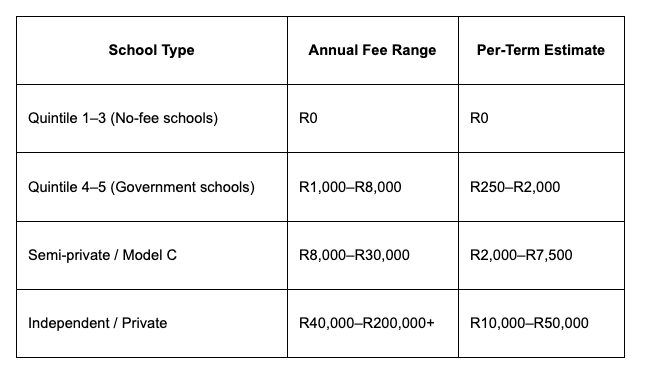
Key reminder: No-fee schools (Quintile 1–3) may not legally charge tuition fees. If unsure, contact the Department of Basic Education or your school’s admin office.
Budget tip: If you need help covering term fees, a Fido education loan can help you access funds quickly and repay on payday.
Category 2: School Uniform
School uniforms are non-negotiable at most institutions and typically include multiple items per child.
Standard Uniform Checklist
- Shirt / blouse
- Shorts / trousers / skirt
- Jersey or sweater
- Socks
- Shoes
- PE kit (sportswear)
- School bag
Estimated Cost (per child)
(Varies by school and quality of items)
Money-saving tip:
Check if your school has a uniform exchange program or second-hand shop. Local Facebook groups often list affordable, gently used uniforms.
Category 3: Stationery and School Supplies
Schools issue detailed stationery lists per grade. While individual items are cheap, the full list adds up quickly.
Primary School (Grades 1–7)
- Pencils and erasers
- Pens
- Ruler
- Exercise books
- Coloring pencils
- Glue and scissors
- Pencil case
High School (Grades 8–12)
- Calculators
- Mathematical sets
- Files and dividers
- Additional subject-specific books
Estimated Stationery Cost
(Total varies per grade and school requirements)
Money-saving tip:
Look out for back-to-school sales at Checkers, Pick n Pay, and Makro in November–January. December sales often offer the best value.
Category 4: Transport to School
This is one of the most overlooked costs — yet often one of the largest monthly expenses.
Transport Options
- School bus fees
- Taxi or minibus transport
- Private car fuel costs
- Ride-hailing services (Uber/Bolt)
- Carpool arrangements
Money-saving tip:
Carpooling with other parents can significantly reduce transport costs by splitting daily expenses.
Category 5: Technology and Devices
Many South African schools now require digital tools for learning.
Possible Requirements
- Tablets or laptops
- Internet/data access
- Headphones
- Learning apps or subscriptions
Important: Always confirm with the school before purchasing. Some schools provide loan devices or have shared learning systems.
Category 6: Extramurals and Sport
Extracurricular activities are an important part of school life and often come with additional costs:
- Sports team fees
- Jerseys and kits
- Music lessons
- Cultural activities
- Competition fees
- Travel for events
Category 7: Food and Tuck Shop Budget
Daily food costs are often underestimated but add up quickly.
- Tuck shop money
- Packed lunches
- Drinks and snacks
- Weekly food planning
The Complete Back-to-School Budget Estimate
Here’s a realistic estimate for one child at a government school for the January term:
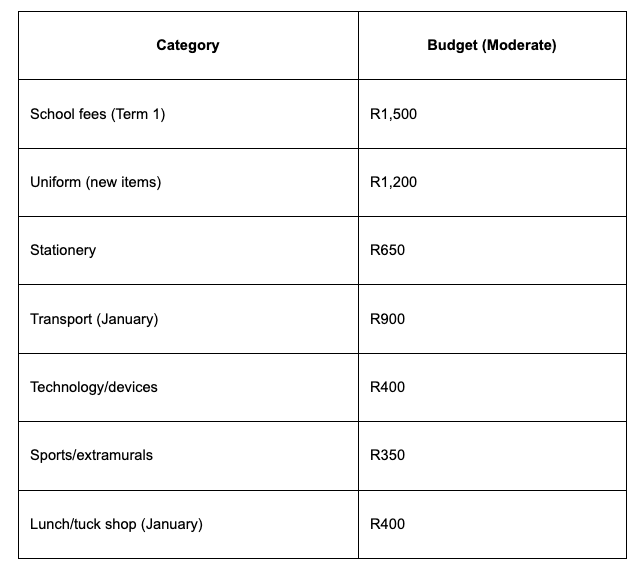
Total:
R5,400 per child
For two children: R10,800
For private school: significantly higher.
This is why an education loan that covers the full list — not just fees — can make a real difference.
Fido education loans cover: fees, uniforms, stationery, transport, and more — with repayment aligned to your payday.
How to Stretch Your Back-to-School Budget
Shop in December, Not January
January is peak season. Prices rise and stock runs out fast. December shopping saves both money and stress.
Buy Only What’s on the List
Stick strictly to the school-issued stationery list. Avoid unnecessary extras.
Reuse Before Replacing
Check last year’s supplies before buying new items. Many can be reused.
Buy Second-Hand First
Uniform exchanges, Facebook Marketplace, and school WhatsApp groups are great sources for affordable items.
Ready for the Year? Fido Has You Covered
Back-to-school season doesn’t have to mean back-to-financial-stress.
Use this checklist to understand your real costs, plan ahead where possible, and use Fido’s education loan to bridge the gap where needed.
Fido covers the full list — fees, uniforms, stationery, everything. Repayment on your next payday.
Download the Fido app and apply today — school season sorted.
For one child at a government fee school, expect R4,000-R8,000 for the first term including fees, uniform, stationery, and transport. Private school costs are significantly higher, ranging from R15,000 to R60,000+ per term per child.
Yes. Options include fee exemptions from the school, the Child Support Grant, NSFAS for tertiary students, and short-term education loans through apps like Fido. Fido education loans are available quickly with no paperwork and repayment aligned to your payday.
Complete back-to-school costs include: school fees, uniforms and shoes, stationery, transport, technology/devices, sports fees and kit, extramural activity costs, and daily lunch. Most families underestimate total costs by 30-40% by forgetting transport and extramurals.
Start in November or early December. January prices are peak and stock runs out. Uniform exchanges run in October/November. Stationery deals are available at major retailers from late November.